
SEO vs. AEO vs. GEO: Which One Actually Matters for Your Business?
The Quick Answer:
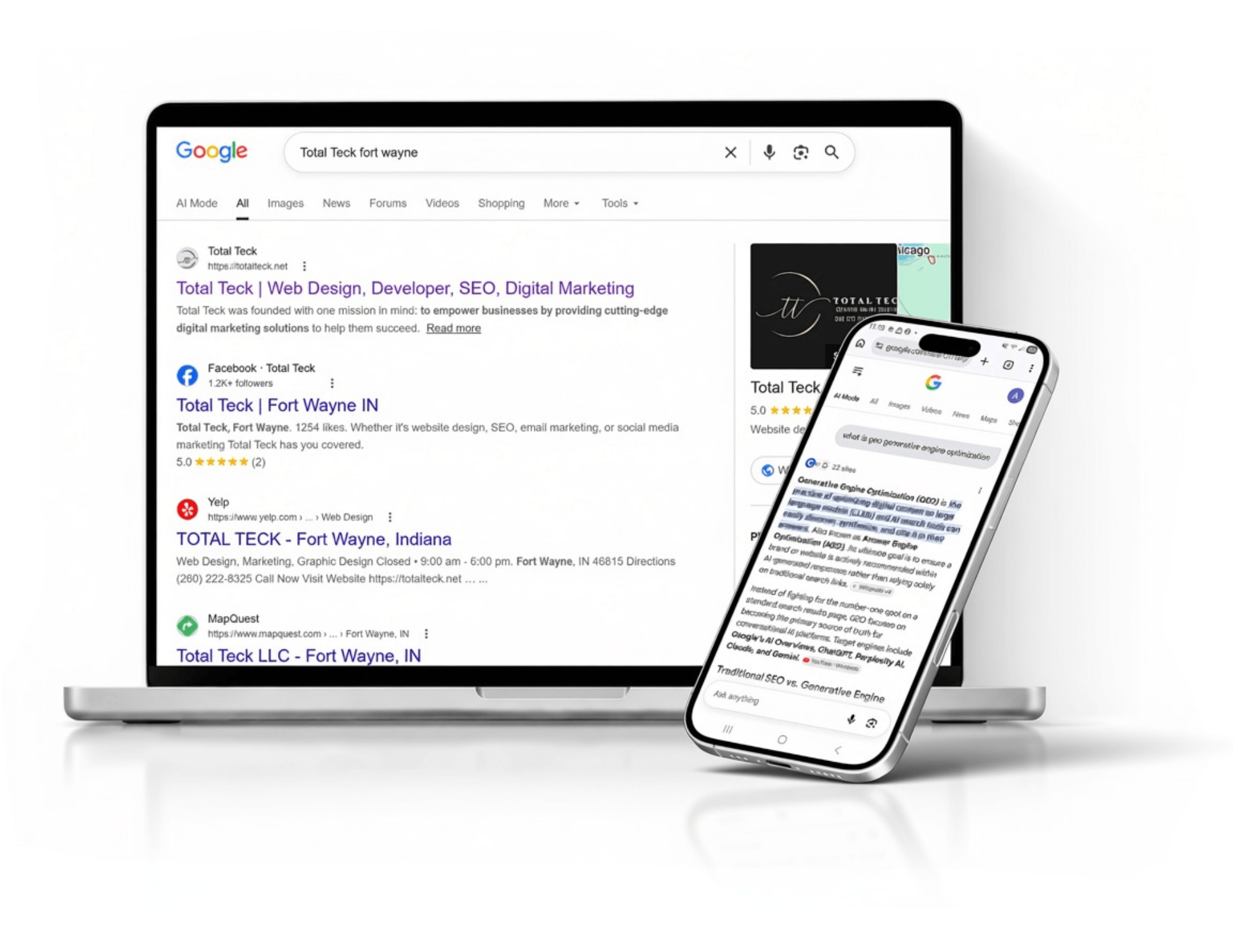
SEO (Search Engine Optimization) helps your website rank higher in traditional search results. AEO (Answer Engine Optimization) helps your content become the direct answer shown in AI Overviews and voice search. GEO (Generative Engine Optimization) helps AI platforms like ChatGPT, Gemini, Claude, and Perplexity understand, trust, and recommend your business. Modern websites should optimize for all three to maximize online visibility.
Search Has Changed. Has Your Website?
For years, businesses only had one goal: rank higher on Google. That strategy worked, until search itself began to evolve.
Today, your customers don’t just type keywords into a search engine. They ask questions to ChatGPT. They use Google AI Overviews. They search with Gemini, Copilot, Siri, Alexa, and countless AI-powered tools that summarize answers instead of simply displaying a list of websites.
The businesses earning the most visibility aren’t just optimizing for search engines anymore—they’re optimizing for artificial intelligence.
That’s where SEO, AEO, and GEO come together.
These aren’t competing strategies. They’re three pieces of the same digital marketing puzzle, each helping your business get discovered in a different way.
If your website is only built for yesterday’s search engines, you’re already falling behind.
This guide will show you exactly what SEO, AEO, and GEO are, how they work together, and what your business should be doing today to stay visible tomorrow.
Table of Contents
1. Search Has Changed. Has Your Website?
2. Search Is Undergoing Its Biggest Transformation in 25 Years
4. What Is Answer Engine Optimization (AEO)?
5. What Is Generative Engine Optimization (GEO)?
6. How Search Actually Works Today
7. SEO vs. AEO vs. GEO: Side-by-Side Comparison
8. How Total Teck Builds for Modern Search
9. Common Mistakes Businesses Make
Search Is Undergoing Its Biggest Transformation in 25 Years
Think about how you searched for information ten years ago.
You probably opened Google, typed in a few keywords, clicked through several websites, compared information, and eventually made a decision.
Today, they ask:
“Who builds custom websites near me?”
“What’s the best CRM for contractors?”
“Can AI answer my business phone?”
“How much does a custom website cost?”
Within seconds, AI provides a summarized answer pulled from dozens of trusted sources. The customer receives exactly what they need without opening multiple browser tabs.
This shift is changing how businesses compete online.
Instead of simply trying to rank #1 on Google, companies now need to become the source AI trusts enough to reference. That’s a very different challenge.
Search Isn’t Dying—It’s Evolving
Some headlines claim SEO is dead. Others insist AI will replace websites altogether.
Neither is true.
Search is simply becoming smarter. Google still indexes billions of pages. People still visit websites before making important purchasing decisions. Businesses still rely on organic traffic.
What’s changing is how information is delivered.
Instead of presenting users with ten blue links, search engines increasingly provide direct answers. Those answers come from websites that demonstrate expertise, authority, clarity, and trust.
That’s why SEO, AEO, and GEO work together rather than compete.
The New Search Journey
A typical customer journey in 2026 might look like this:
- Ask ChatGPT a question.
- Read an AI-generated summary.
- Compare two or three recommended businesses.
- Visit one or two websites.
- Contact the company that appears most trustworthy.
Notice something?
The website still matters. In many cases, it matters more than ever because it’s now responsible for validating the recommendation AI already made.
That means your website needs to do two jobs exceptionally well:
- Help AI understand your business.
- Convince real people to choose your business.
The companies that accomplish both will continue winning online.
What Is SEO?
Search Engine Optimization (SEO) is the process of improving your website so search engines like Google and Bing can understand your content and rank it higher in search results.
At its core, SEO helps search engines answer one simple question:
“Is this the best page for this search?”
When someone searches for:
- Website designer
- Roofing company
- AI phone receptionist
- Ecommerce development
- Digital marketing agency
Google evaluates thousands—sometimes millions—of pages before deciding which ones deserve to appear first.
The better your website communicates relevance, authority, and quality, the higher it has the potential to rank.
The Four Pillars of Modern SEO
1. Technical SEO
Your website needs a strong technical foundation.
This includes:
- Fast loading speeds
- Mobile responsiveness
- Secure HTTPS connections
- Clean code
- Proper indexing
- XML sitemaps
- Structured data
- Core Web Vitals optimization
Without a healthy technical foundation, even excellent content can struggle to rank.
2. On-Page SEO
Every page should clearly communicate what it’s about.
This involves optimizing:
- Page titles
- Meta descriptions
- Headings
- Internal links
- Images
- Alt text
- Keywords
- URL structure
- Content organization
Good on-page SEO isn’t about stuffing keywords into paragraphs. It’s about making information easier for both people and search engines to understand.
3. Content
Content remains one of the strongest ranking factors.
Google rewards websites that consistently publish valuable, original, and helpful information.
This includes:
- Service pages
- Blog articles
- FAQs
- Case studies
- Resource centers
- Industry guides
The more expertise your website demonstrates, the more likely search engines are to view your business as an authority.
4. Authority
Search engines also evaluate your reputation across the web.
Signals include:
- High-quality backlinks
- Positive reviews
- Brand mentions
- Citations
- Industry recognition
- Consistent business information
Think of authority as your website’s reputation score. The more trustworthy your business appears, the stronger your rankings can become.
What SEO Does Well
SEO excels at helping businesses appear when customers actively search for products or services.
Examples include:
- “Website designer near me”
- “Commercial roofing company”
- “Best ecommerce developer”
- “Digital marketing agency”
When done correctly, SEO generates long-term traffic without paying for every visitor.
Unlike paid advertising, strong organic rankings can continue delivering leads for years. That makes SEO one of the highest-return marketing investments available.
But SEO Has Changed
Traditional SEO focused heavily on keywords.
Modern SEO focuses on people. Google increasingly rewards websites that answer questions naturally, demonstrate expertise, and provide genuinely useful information.
What Is AEO?
Imagine asking Google:
“How much does a custom website cost?”
Instead of seeing ten blue links, Google immediately provides a detailed answer at the very top of the page.
Or perhaps you ask Siri:
“Who builds custom websites near me?”
Within seconds, Siri responds with a single recommendation instead of asking you to browse dozens of websites.
This is Answer Engine Optimization (AEO) in action. Rather than simply trying to rank your website higher in search results, AEO focuses on making your content the answer itself.
It’s one of the biggest shifts in digital marketing because users increasingly expect immediate answers, not long lists of websites.
What Is Answer Engine Optimization?
Answer Engine Optimization is the process of structuring your website and content so search engines and AI-powered assistants can quickly understand, summarize, and present your information as the direct answer to a user’s question.
Think of AEO as writing content that says:
“If someone asks this question, here’s the best answer.”
Instead of optimizing for keywords alone, you’re optimizing for questions, intent, clarity, and authority.
This approach benefits:
- Google AI Overviews
- Google Featured Snippets
- Bing Copilot
- Siri
- Alexa
- Voice Search
- AI-powered search assistants
- Smart devices
In other words, AEO helps your business become the trusted source that powers answers across the modern web.
Why Answers Are Becoming More Important Than Rankings
Search behavior has changed dramatically over the past few years.
People no longer search like this:
website designer
Today, they’re much more likely to ask:
- Who builds custom websites for contractors?
- How much does a custom website cost?
- What’s the difference between a template website and a custom website?
- Can AI answer my business phone?
- Why isn’t my website getting leads?
These aren’t just keywords—they’re conversations.
AI systems are designed to understand natural language, recognize intent, and provide complete answers.
That means your content needs to be written for the way people actually ask questions.
From Search Engines to Answer Engines
Traditional search worked like a librarian.
You asked for a topic. Google handed you a list of books. You found the answer yourself.
Today’s AI works more like a knowledgeable consultant.
You ask a question. It researches dozens of trusted sources. Then it gives you a concise answer.
That changes how content needs to be written.
Instead of simply targeting keywords, every page should clearly answer the questions your customers are already asking.
What Makes Content AEO-Friendly?
Content designed for Answer Engine Optimization has several characteristics in common.
It Answers Questions Immediately
One of the biggest mistakes businesses make is taking five paragraphs before answering a simple question.
If someone asks:
What is a Smart Website?
Don’t wait until halfway through the article.
Answer it immediately. Then explain it in greater detail afterward. This simple structure makes your content easier for both readers and AI systems to understand.
It Uses Clear Headings
AI models rely heavily on headings to understand page structure.
Instead of vague headings like:
Our Thoughts
Use headings like:
- What Is a Smart Website?
- How Does an AI Voice Assistant Work?
- Why Does Website Speed Matter?
- How Much Does Website Hosting Cost?
Clear headings improve readability while helping AI identify the information users need.
It Uses Natural Language
Modern search engines understand conversations.
Your writing should sound like a knowledgeable expert—not a machine trying to rank for keywords.
For example:
Instead of writing:
Website design company custom website services website development…
Write naturally:
A custom website gives your business complete control over design, functionality, performance, and customer experience. Unlike template websites, it’s built specifically around your goals rather than forcing your business into a pre-built layout.
Natural language is easier for humans to read and easier for AI to interpret.
It Organizes Information Logically
Good AEO content flows naturally. Readers should never feel lost.
That means:
- Short paragraphs
- Descriptive headings
- Numbered lists
- Bullet points
- Tables
- Definitions
- Examples
- FAQs
Well-structured content allows AI systems to quickly identify relevant information without guessing.
Why FAQs Have Become So Powerful
One of the easiest ways to improve AEO is by answering real customer questions. Every question becomes another opportunity for your website to appear in AI-generated answers.
For example, a page about AI Voice Assistants might answer:
- What is an AI Voice Assistant?
- Can AI answer my business phone?
- Does AI sound human?
- Can AI schedule appointments?
- Can AI transfer calls?
- Is AI available after hours?
- How much does AI cost?
- Can AI learn my business?
- Can AI answer multiple callers at once?
- Is AI secure?
One page can potentially rank—or be referenced—for dozens of different searches.
That’s incredibly valuable.
Featured Snippets vs AI Overviews
Many people assume these are the same thing.
They’re not.
| Featured Snippets | AI Overviews |
|---|---|
| Pull information from a single source | Combine information from multiple trusted sources |
| Usually appear as a paragraph or list | Generate a conversational summary |
| Often link directly to one website | May reference several websites |
| Primarily keyword-focused | Primarily intent-focused |
Both reward high-quality, well-organized content. The difference is that AI Overviews evaluate the broader context instead of relying on a single paragraph.
AEO Isn’t Replacing SEO
This is one of the biggest misconceptions. AEO builds upon SEO; it doesn’t replace it. Think about building a house. SEO is the foundation. Without it, the house isn’t stable. AEO is the interior design. It makes the house functional, welcoming, and easy to navigate.
You need both. A website with excellent SEO but poor AEO may rank well but struggle to appear in AI-generated answers. Likewise, beautifully written answers won’t perform if the website loads slowly, has technical issues, or lacks authority.
The strongest websites combine technical excellence with exceptional content.
Businesses That Benefit Most from AEO
Almost every business can benefit, but it’s especially valuable for companies whose customers ask lots of questions before making a purchase.
Examples include:
- Website design agencies
- Home service companies
- Medical practices
- Law firms
- Financial advisors
- Contractors
- Restaurants
- Manufacturers
- Real estate companies
- Professional service providers
- Software companies
- Ecommerce businesses
If your customers search before they buy, AEO matters.
The Business Impact of Better Answers
Businesses often focus on rankings. Customers focus on trust. When your content consistently provides helpful, accurate, and easy-to-understand answers, several things happen naturally:
- Visitors stay on your website longer.
- They view more pages.
- They trust your expertise.
- They contact you with greater confidence.
- They convert at higher rates.
In other words, better answers don’t just improve visibility; they improve business outcomes.
Introducing the Next Evolution: GEO
If SEO helps search engines understand your website…And AEO helps search engines answer questions…Then GEO takes things one step further.
It helps generative AI systems understand your expertise, trust your content, and confidently reference your business when creating original responses.
This isn’t about ranking higher on a search results page. It’s about becoming part of the AI’s knowledge ecosystem, and for many businesses, that will become one of the most important sources of visibility over the next decade.
Total Teck Insight
The businesses that dominate tomorrow’s search results won’t be the ones with the most keywords, they’ll be the ones that consistently provide the clearest, most trustworthy, and most helpful answers. AEO is no longer an optional enhancement to SEO; it’s becoming a core part of how customers discover and evaluate businesses online.
What Is GEO?
If SEO was built for search engines and AEO was built for answer engines, GEO (Generative Engine Optimization) is built for artificial intelligence.
It’s one of the newest—and most misunderstood—areas of digital marketing.
Many business owners assume GEO is simply another buzzword for SEO. It isn’t. While SEO helps your website appear in search results and AEO helps your content become direct answers, GEO focuses on something entirely different:
Helping generative AI understand, trust, and reference your business when creating original responses.
That distinction is becoming increasingly important as millions of people begin their buying journey with AI instead of a traditional search engine.
What Is Generative Engine Optimization?
Generative Engine Optimization (GEO) is the practice of creating websites and content that AI systems can easily understand, verify, summarize, and confidently use when generating answers.
Unlike traditional search engines, generative AI doesn’t simply rank pages.
Instead, it analyzes information from many sources, identifies patterns, evaluates credibility, and generates an original response based on everything it understands.
Your goal isn’t just to be found. Your goal is to become one of the trusted sources AI relies on.
Think of GEO Like This…
Imagine asking five experts the same question. If four experts consistently recommend the same company, you’re much more likely to trust that recommendation.
Generative AI works in a similar way. It looks across trusted information, compares what it finds, and builds an answer based on confidence, not just rankings.
That means your website should consistently communicate:
- Who you are
- What you do
- Who you serve
- Where you serve
- Why you’re different
- Why you’re trustworthy
The clearer and more consistent your digital presence is, the easier it is for AI to understand your business.
How AI Finds Information
One of the biggest misconceptions about AI is that it “knows everything.”
It doesn’t.
Modern AI systems use a combination of:
- Public websites
- Structured data
- Business profiles
- Knowledge graphs
- Trusted publications
- Documentation
- Reviews
- Industry resources
- Search indexes
- Current web retrieval (for some AI platforms)
Then they analyze relationships between those sources. They look for consistency, authority, clarity, and trustworthiness.
This means your website is no longer competing with just other websites. It’s competing to become a trusted source within an entire information ecosystem.
GEO Is About Trust
Imagine two websites.
Website A says:
We build amazing websites.
Website B explains:
- What custom websites are
- How they’re built
- Why they perform better
- Real client examples
- Case studies
- FAQs
- Industry best practices
- Supporting articles
- Original graphics
- Helpful comparisons
Which one is an AI system more likely to reference?
The second one. Not because it’s longer, but because it demonstrates expertise. AI rewards depth, clarity, and usefulness. That’s exactly what GEO encourages.
GEO Is More Than Keywords
Traditional SEO often revolved around matching keywords. Modern AI understands concepts.
For example, our page about Smart Websites may never repeat the exact phrase:
“intelligent business website”
Yet AI understands those concepts are closely related. That’s why semantic writing has become so important.
Instead of repeating the same keyword dozens of times, strong GEO content naturally discusses related ideas such as:
- automation
- customer experience
- conversational AI
- lead generation
- integrations
- personalization
- machine learning
- workflow optimization
- business efficiency
The broader and more complete your coverage, the easier it becomes for AI to understand your expertise.
What Makes a Website GEO-Friendly?
Several characteristics consistently appear on websites that perform well in AI-powered search experiences.
Original Expertise
AI values information that demonstrates firsthand knowledge.
That means sharing:
- Real client experiences
- Original insights
- Lessons learned
- Industry observations
- Practical advice
- Custom illustrations
- Case studies
Content created from genuine experience carries more value than generic summaries.
Topical Authority
One article isn’t enough.
Imagine trying to become known as an expert in construction after writing a single blog post.
It wouldn’t happen.
The same principle applies online.
A business that publishes:
- 100 website articles
- 50 SEO articles
- 40 AI articles
- dozens of case studies
appears far more authoritative than a competitor with only five generic blog posts.
That’s why Total Teck’s pillar strategy is so powerful.
Each article reinforces the others.
Each supporting article strengthens the entire topic.
Over time, the website becomes an authoritative knowledge center instead of simply a marketing brochure.
Consistency
AI looks for consistency across your online presence.
Your messaging should align everywhere.
Your website.
Your service pages.
Your Google Business Profile.
Your case studies.
Your social media.
Your directory listings.
Your business descriptions.
Conflicting information creates uncertainty.
Consistent information builds confidence.
Clear Website Architecture
AI prefers organized information.
That means:
- Logical navigation
- Strong internal linking
- Related articles
- Service clusters
- Resource hubs
- Topic categories
- Clean URLs
Think of your website as a well-organized library rather than a pile of books.
The Rise of Topical Authority
One of the biggest changes AI has introduced is the importance of topical authority.
Instead of asking:
Does this page deserve to rank?
AI increasingly asks:
Does this website truly understand this subject?
A company with one article about SEO is less likely to become a trusted authority than a company with:
- SEO
- AEO
- GEO
- Schema
- Technical SEO
- Website speed
- Content strategy
- Local SEO
- AI search
- Voice search
- Internal linking
- Structured data
- Search trends
All connected. That’s exactly why content clusters work. Every article strengthens the next.
How GEO Changes Content Strategy
Older content strategies often focused on quantity. Publish lots of articles, target lots of keywords, hope something ranks.
Modern GEO favors completeness.
One outstanding article can outperform dozens of thin blog posts if it genuinely answers every important question surrounding a topic. That’s why every Total Teck pillar article will function as a true resource, not a 700-word opinion piece.
Our goal isn’t simply to rank. Our goal is to become the resource other websites, search engines, and AI systems recognize as authoritative.
GEO Rewards Helpful Content
Google has long emphasized “helpful content.” Generative AI takes that concept even further.
Ask yourself:
- Does this article genuinely solve a problem?
- Would someone bookmark it?
- Would they share it?
- Would another professional recommend it?
If the answer is yes, you’re creating content AI wants to surface.
Why This Matters for Small Businesses
Some business owners hear terms like GEO and assume it’s only relevant for large national brands.
The opposite is often true. Small businesses have a unique advantage. They possess firsthand experience; they know their customers, and they solve real problems every day.
By turning that experience into high-quality educational content, local businesses can compete with companies many times their size.
Authority is no longer determined solely by budget. It’s increasingly determined by expertise and the ability to communicate that expertise clearly.
SEO + AEO + GEO: Better Together
It’s tempting to ask which strategy is the most important.
The better question is:
How do they work together?
Think of them as three layers of the same strategy.
| Strategy | Primary Goal | Best For |
|---|---|---|
| SEO | Ranking in traditional search engines | Google & Bing search results |
| AEO | Becoming the direct answer | AI Overviews, Featured Snippets, Voice Search |
| GEO | Becoming a trusted AI source | ChatGPT, Gemini, Claude, Perplexity, Copilot and future AI platforms |
Each serves a different purpose.
Together, they create a modern search strategy built for both humans and artificial intelligence. Ignoring one creates a gap. Combining all three creates a competitive advantage.
Total Teck Insight
The future won’t belong to businesses with the most blog posts, it will belong to businesses with the clearest expertise.
That’s why every article we create is designed to educate first, build trust second, and generate leads naturally. Rankings are the outcome of becoming genuinely helpful, not the goal itself.
How Search Actually Works Today
Not long ago, getting found online was relatively straightforward. Someone searched for a keyword, Google returned a list of websites, and the user clicked a result.
Today, that journey is far more dynamic.
A customer might begin by asking ChatGPT a question during breakfast, continue researching on Google during lunch, compare businesses on their phone that afternoon, and finally submit a contact form later that evening. At every stage, different technologies are evaluating your website—and each one has slightly different expectations.
Understanding this modern search journey is the key to building a website that performs well across traditional search engines, AI-powered platforms, and voice assistants.
The Modern Customer Journey
Let’s imagine Sarah owns a plumbing company and wants a new website.
Ten years ago, her search might have looked like this:
Google Search : Website designer
She clicked several websites, compared portfolios, and eventually made a decision.
Today, her journey is more likely to unfold like this:
Step 1 — She Starts with AI
Sarah opens ChatGPT and asks:
“What’s the difference between a template website and a custom website for a plumbing company?”
Instead of receiving links, she gets a detailed explanation. Several concepts are introduced, and she learns about:
- Custom design
- SEO
- Lead generation
- Mobile optimization
- AI-powered customer support
At this stage, she isn’t looking for a company. She’s looking for understanding.
Step 2 — She Asks Follow-Up Questions
Now she’s curious, so she asks:
- How much does a custom website cost?
- How long does it take?
- Is WordPress better than Wix?
- Can AI answer my business phone?
- What should a plumbing website include?
Notice what’s happening?
She isn’t searching keywords; she’s having a conversation. Every one of those questions represents an opportunity for an authoritative website to become part of the answer.
Step 3 — AI Recommends Businesses
Eventually Sarah asks:
“Who builds websites for plumbing companies?”
Now AI begins evaluating trusted businesses. It considers factors like:
- Website quality
- Expertise
- Content depth
- Reviews
- Reputation
- Topical authority
- Structured information
- Consistency across the web
This is where GEO becomes incredibly important. AI isn’t simply counting keywords. It’s evaluating credibility.
Step 4 — Sarah Visits the Website
Only now does she arrive on your website.
This moment is critical. Many businesses spend so much time trying to generate traffic that they forget the website itself still has to convert visitors into customers.
The recommendation got you in the door. Your website closes the sale.
Step 5 — She Makes a Decision
Within just a few minutes, Sarah decides whether your business feels trustworthy. She’s asking herself questions like:
- Does this company understand my industry?
- Can they solve my problem?
- Do they have real experience?
- Is their work modern?
- Can I trust them?
Your design, messaging, portfolio, case studies, and educational content all contribute to that decision.
Search brought her there. Trust wins the business.
Why Authority Beats Tricks
There was a time when businesses could manipulate search results with tactics like:
- Keyword stuffing
- Hidden text
- Thousands of low-quality backlinks
- Duplicate pages
- Thin content
- Spammy blog posts
Those tactics don’t just fail today. They can actively hurt your visibility.
Modern search engines and AI systems are designed to reward businesses that demonstrate genuine expertise. That means creating content that answers real questions, showcases real experience, and provides real value.
There are no shortcuts to becoming a trusted authority.
What Search Engines Evaluate Today
When someone performs a search, Google isn’t asking:
“Who used this keyword the most?”
Instead, it’s evaluating hundreds of signals to determine whether a page deserves to be shown. Some of the most influential include:
Relevance
- Does the page actually answer the user’s question?
Experience
- Does the content reflect real-world knowledge and practical expertise?
Authority
- Has the website consistently demonstrated expertise on this topic?
Trust
- Can users—and search engines—confidently rely on the information?
Performance
- Does the website load quickly, function properly, and provide a good experience on every device?
Organization
- Is the content structured in a way that’s easy to understand?
Collectively, these signals help determine which websites are most deserving of visibility.
What AI Evaluates
Generative AI looks at many of the same qualities but with a different objective.
Instead of deciding:
Which page should rank first?
AI asks:
Which information should I trust enough to include in my answer?
That subtle difference changes everything. AI favors content that is:
- Well organized
- Easy to summarize
- Factually accurate
- Consistent
- Comprehensive
- Clearly written
- Supported by related content
- Demonstrative of real expertise
This is why long-form pillar content has become so valuable. A thorough guide answers multiple questions in one place, making it easier for AI to understand the complete picture.
Why Content Clusters Matter More Than Ever
Imagine two competing websites.
Website A
Has:
- Home Page
- About
- Services
- Contact
That’s it.
Website B (Total Teck Strategy)
Has:
- Home
- About Page
- Service Pages
- Contact
- Pillar Guides
- Supporting Articles
- Case studies
- FAQs
- Client Success Stories
Which company appears more knowledgeable?
Which company gives AI more confidence?
Which company demonstrates deeper expertise?
The answer is obvious. Every article strengthens the authority of every other article. Instead of isolated pages competing independently, they work together to establish your website as the go-to resource within your industry.
The New Goal: Become the Best Answer
Many businesses still chase rankings as though being #1 is the finish line.
It’s not. The real objective is to become the best answer, regardless of where the question is asked.
Whether someone searches on Google, asks ChatGPT, speaks to Alexa, uses Gemini, or consults the next generation of AI-powered search tools, your content should consistently demonstrate that your business is the most knowledgeable, trustworthy, and helpful resource available.
You shouldn’t be writing blog posts simply to fill a content calendar.
You should be building an authoritative knowledge base designed to educate customers, earn trust, and increase visibility across every major search experience.
Total Teck Insight
Search engines rank websites. AI recommends expertise. The businesses that will dominate the next decade are those that stop thinking in terms of pages and start thinking in terms of knowledge. Every article, service page, case study, and FAQ should work together to answer one question: “Why should someone trust us?”
SEO vs. AEO vs. GEO: Side-by-Side Comparison
At first glance, SEO, AEO, and GEO may sound like three competing strategies. In reality, they’re designed to work together.
Think of them as three different ways customers discover your business.
- SEO helps people find your website through traditional search engines.
- AEO helps your content become the direct answer to a customer’s question.
- GEO helps AI platforms understand your expertise and confidently recommend your business during conversational searches.
The companies that succeed over the next decade won’t choose one over the others; they’ll build a digital presence that performs well across all three.
| Feature | SEO | AEO | GEO |
|---|---|---|---|
| Primary Goal | Rank higher in search results | Become the direct answer | Become a trusted AI source |
| Optimized For | Google, Bing | AI Overviews, Featured Snippets, Voice Search | ChatGPT, Gemini, Claude, Perplexity, Copilot |
| Focus | Keywords, authority, technical optimization | Questions, concise answers, structured content | Expertise, topical authority, semantic relationships |
| Success Metric | Rankings & organic traffic | Featured answers & AI summaries | AI citations, recommendations & brand visibility |
| Best Content | Service pages, blogs, landing pages | FAQs, definitions, step-by-step guides | Pillar content, case studies, knowledge hubs |
| Time Horizon | Long-term | Long-term | Long-term and continually evolving |
The important takeaway is that none of these strategies replace the others. Instead, each strengthens the next. A technically sound website (SEO) provides the foundation. Clear, well-structured answers (AEO) improve visibility in modern search experiences. Comprehensive, trustworthy content (GEO) positions your business as an authority that AI systems can confidently reference.
How Total Teck Builds for All Three
At Total Teck, we don’t treat SEO, AEO, and GEO as separate services; they’re integrated into every website we build.
Our process focuses on creating websites that are designed for today’s search engines while preparing businesses for tomorrow’s AI-driven search experiences.
That includes:
- Fast, secure, high-performance websites
- Clean information architecture
- Strategic internal linking
- Structured content that answers customer questions
- Conversion-focused service pages
- Original educational resources
- AI-friendly content organization
- Scalable content strategies built around topical authority
Rather than chasing algorithm updates, we build websites that prioritize clarity, expertise, and exceptional user experience. Qualities that consistently perform well regardless of how search technology evolves.
Common Mistakes Businesses Make
Even businesses investing in digital marketing often overlook opportunities to improve their visibility across modern search platforms.
Here are some of the most common mistakes we see.
1. Treating SEO as a One-Time Project
SEO isn’t something you “finish.” Search behavior, competitors, and technology evolve constantly. Successful websites are continually refined and expanded.
2. Content Without a Strategy
Random blog posts rarely build authority.
Content should be organized into topic clusters, with supporting articles reinforcing comprehensive pillar pages like this one.
3. Writing Only for Search Engines
Keyword stuffing and awkward phrasing no longer work.
Write for real people first. Search engines and AI systems increasingly reward content that’s clear, helpful, and easy to understand.
4. Ignoring AI Search
Many businesses are still optimizing exclusively for traditional search engines.
As AI-powered search continues to grow, businesses that fail to adapt risk losing visibility before potential customers ever reach their website.
5. Weak Internal Linking
Every important page on your website should support another.
Strong internal linking helps visitors discover related content while making it easier for search engines and AI systems to understand how your website is organized.
6. Thin Service Pages
A service page containing only a few paragraphs rarely demonstrates expertise.
Comprehensive, informative pages build trust, improve rankings, and answer customer questions before they ever pick up the phone.
7. Forgetting About User Experience
A beautiful website means little if it’s slow, confusing, or difficult to navigate.
Search engines increasingly reward websites that provide a fast, intuitive experience across every device.
8. Measuring Rankings Instead of Results
The ultimate goal isn’t simply appearing higher in search results.
It’s generating qualified leads, building trust, and growing your business. Successful digital strategies focus on meaningful business outcomes, not vanity metrics.
The Short Answers:
1. What is the difference between SEO, AEO, and GEO?
SEO helps your website rank in traditional search engines. AEO helps your content become the direct answer in AI Overviews, featured snippets, and voice search. GEO focuses on making your business a trusted source that generative AI platforms can understand, summarize, and recommend. Together, these strategies create a comprehensive approach to modern online visibility.
2. Is SEO still important with the rise of AI?
Absolutely. SEO remains the foundation of online visibility. Without a technically sound, well-optimized website, it’s much harder for search engines and AI platforms to understand your content. AI has expanded SEO; it hasn’t replaced it.
3. What is Answer Engine Optimization (AEO)?
AEO is the practice of creating clear, well-structured content that directly answers user questions. This increases the likelihood of your content appearing in AI Overviews, featured snippets, and voice search responses.
4. What is Generative Engine Optimization (GEO)?
GEO focuses on helping AI systems like ChatGPT, Gemini, Claude, and Perplexity recognize your website as a trusted source of information. It emphasizes expertise, topical authority, and comprehensive content rather than simple keyword optimization.
5. Do small businesses need GEO?
Yes. Small businesses often have valuable firsthand experience and industry knowledge. By publishing helpful, authoritative content, they can compete effectively with much larger companies in AI-powered search experiences.
6. How long does it take to see results?
SEO, AEO, and GEO are long-term strategies. While improvements may begin appearing within a few months, meaningful authority is built over time through consistent optimization, quality content, and ongoing website updates.
7. Can AI replace a business website?
No. AI helps customers discover businesses, but your website remains your digital headquarters. It’s where visitors evaluate your expertise, explore your services, and ultimately decide whether to contact you.
8. Where should my business start?
Start with a strong website foundation. Ensure your site is technically sound, mobile-friendly, secure, and built around your customers’ needs. From there, develop a content strategy that combines SEO, AEO, and GEO to establish long-term authority and sustainable growth.
Final Thoughts…
Search has entered a new era.
Customers no longer rely on a single search engine or a single device to find the businesses they need. They ask questions, compare recommendations, interact with AI, and expect immediate, trustworthy answers throughout the buying journey.
That shift creates an incredible opportunity for businesses willing to adapt. The organizations that will lead the next generation of online search aren’t simply chasing rankings—they’re becoming recognized experts within their industries. They’re publishing helpful resources, answering real customer questions, demonstrating genuine experience, and building websites designed for both people and artificial intelligence.
SEO, AEO, and GEO aren’t competing strategies. Together, they form a modern framework for building long-term online visibility, earning trust, and attracting qualified customers wherever they choose to search.
If your website is still optimized only for yesterday’s search engines, now is the time to prepare for what’s next.
Related Posts:

Never Miss Another Lead: How AI Voice Assistants Are Changing the Way Businesses Answer
The Quick Answer: An AI voice assistant is conversational software that can answer and manage business phone calls using...

Beyond Templates: Why Custom Websites Win More Customers
The Quick Answer: A custom website is designed and developed specifically for your business rather than built from a pre-made...