
Never Miss Another Lead: How AI Voice Assistants Are Changing the Way Businesses Answer
The Quick Answer:
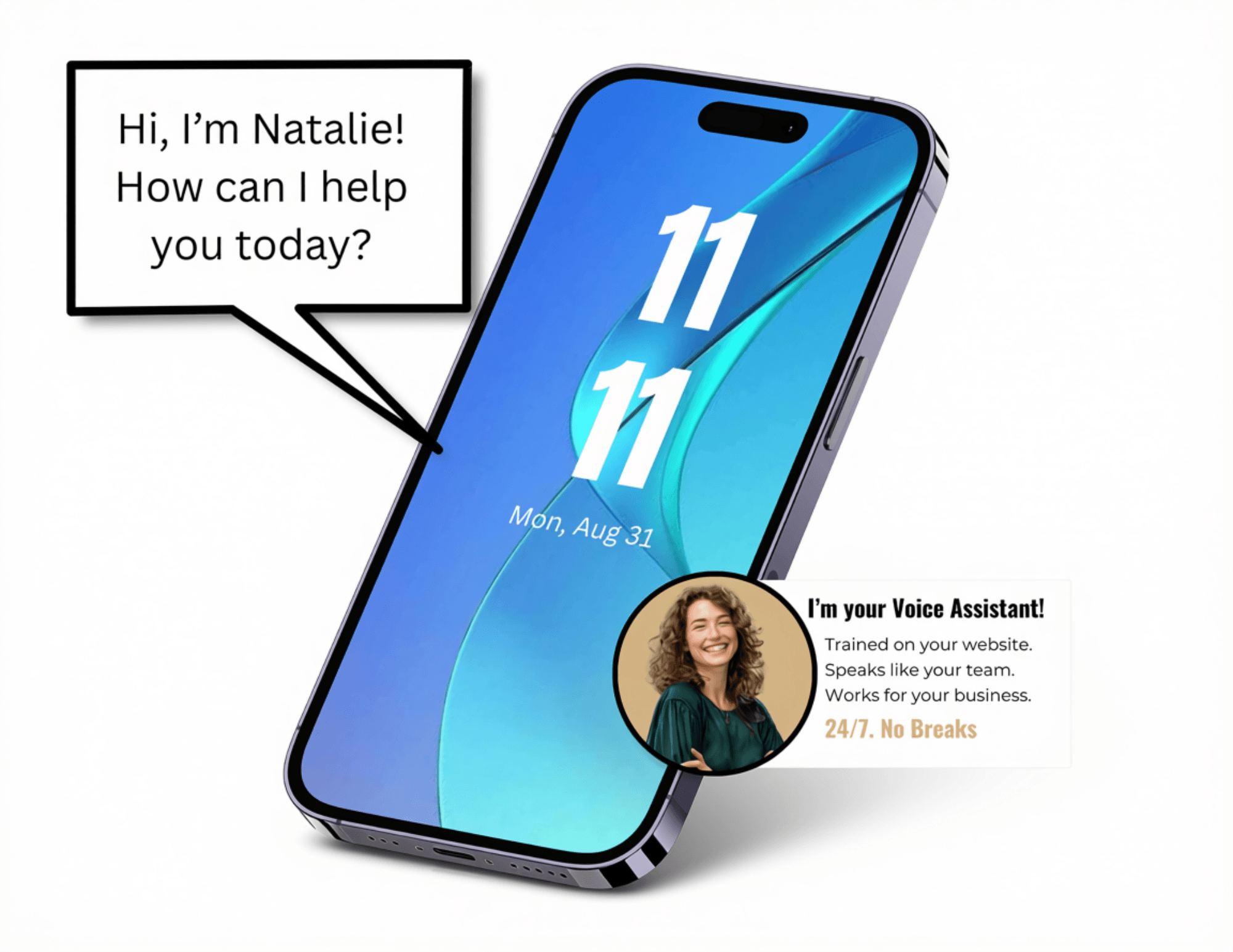
An AI voice assistant is conversational software that can answer and manage business phone calls using artificial intelligence. Unlike traditional automated phone menus, modern AI assistants can understand natural speech, answer questions about a business, capture customer information, schedule appointments, qualify leads, and transfer calls when human assistance is needed.
The Call You Don’t Answer Could Be the Customer You Never Get
It’s 7:14 p.m. on a Tuesday.
A homeowner discovers water leaking through the ceiling and immediately starts searching for someone who can help. They find a local contractor, visit the website, and call.
No answer. They don’t leave a voicemail. Instead, they return to their search and call the next company.
That business answers. The first company never even knows the opportunity existed.
This happens every day across almost every industry. Calls arrive while employees are helping other customers, working in the field, sitting in meetings, taking lunch, driving between appointments, or simply trying to go home at the end of the day. Even businesses with dedicated receptionists can’t guarantee that every call will be answered immediately.
Customer expectations haven’t become nearly as forgiving. People have grown accustomed to getting information instantly, and when they’re ready to buy, schedule, or request help, waiting until tomorrow can feel like an eternity.
That’s the problem AI voice assistants are beginning to solve.
An AI voice assistant can answer incoming business calls, speak naturally with customers, respond to common questions, collect lead information, schedule appointments, route calls, and handle routine conversations without requiring someone on your team to stop what they’re doing.
More importantly, it can do those things at 7:14 on a Tuesday night.
The opportunity doesn’t have to disappear just because your office is closed.
Table of Contents
1. The Call You Don’t Answer Could Be the Customer You Never Get
2. What Is an AI Voice Assistant?
3. Why Businesses Are Turning to AI
4. What an AI Voice Assistant Can Actually Do
5. AI Receptionist vs. Human Receptionist
6. How AI Learns Your Business
What Is an AI Voice Assistant?
An AI voice assistant is a conversational system designed to communicate with callers using spoken language. Instead of requiring customers to press numbers or navigate a rigid phone tree, the assistant listens to what the caller says, understands the request, and responds conversationally.
That distinction is important.
Most people have encountered traditional automated phone systems. You call a company and hear something like, “Press one for sales. Press two for billing. Press three for customer service.” If your question doesn’t fit neatly into one of those categories, you’re forced through a maze of menus hoping to eventually reach the right person.
AI voice assistants work differently because the conversation can begin with a simple question:
“How can I help you today?”
A customer might respond, “I’m interested in getting a quote for a new website.”
The assistant can recognize that the caller is a potential sales lead and continue the conversation accordingly. It might ask about the caller’s business, collect their contact information, answer introductory questions, and help schedule a consultation.
Another caller might say, “I’m already a customer and I need an update on my project.”
The same assistant can recognize that this is an existing-client request and follow an entirely different conversation path, collecting the appropriate information or transferring the caller when a team member is available.
Instead of forcing people to communicate the way a phone system expects, conversational AI allows the phone system to communicate the way people naturally do.
This Isn’t the Robotic Voice System You Remember
For many business owners, the phrase “automated phone system” immediately brings back unpleasant memories. Robotic voices, endless menus, repeated questions, and the frustration of yelling “REPRESENTATIVE” into the phone aren’t exactly examples of great customer service.
Modern conversational AI is fundamentally different.
Advances in speech recognition, natural language processing, and generative AI allow voice assistants to understand much more natural conversation. Callers can speak normally, interrupt, ask follow-up questions, change topics, or explain a problem in their own words.
The interaction can feel much closer to speaking with a receptionist than navigating an automated system.
That doesn’t mean AI should pretend to be human. Transparency matters, and businesses should be thoughtful about how AI is introduced. The goal isn’t to fool customers. It’s to provide fast, useful assistance when they need it.
A well-designed AI assistant should make the interaction easier, not make technology the center of the conversation.
Why Businesses Are Turning to AI
The biggest reason businesses are adopting AI phone assistants isn’t because AI is trendy. It’s because answering every phone call has always been difficult.
Small businesses face the problem most directly. A contractor may be standing on a jobsite when a prospective customer calls. A medical office receptionist may already be helping a patient. A restaurant employee may be handling a rush. A website agency may have its entire team in client meetings. The phone doesn’t care. It rings anyway.
Hiring additional staff can help, but maintaining enough employees to answer every call immediately, especially evenings, weekends, holidays, and periods of unusually high volume, is expensive and often impractical.
AI introduces another option. Instead of choosing between hiring another employee and allowing calls to go unanswered, businesses can use AI to handle the first layer of communication.
Routine conversations can be handled automatically while situations requiring judgment, empathy, negotiation, or specialized expertise can still be routed to a human.
That distinction is important because the strongest use of AI isn’t replacing every human conversation.
It’s deciding which conversations actually require one.
Your Team Doesn’t Need to Answer Every Question
Think about the questions your employees answer repeatedly.
- “What time do you close?”
- “Do you serve my area?”
- “Do you offer financing?”
- “How do I schedule an appointment?”
- “Can someone give me an estimate?”
- “Where are you located?”
- “Do you offer this particular service?”
Each question may take only a few minutes, but across dozens or hundreds of calls, that time adds up. More importantly, every routine call interrupts whatever your employees were already doing.
An AI voice assistant can handle many of those conversations immediately. Customers get answers without waiting, and employees can remain focused on work that actually requires their attention.
When a conversation becomes more complex, the AI can recognize that a human needs to become involved and move the caller to the appropriate person.
That’s where the real efficiency comes from, not eliminating people, but protecting their time.
After-Hours Calls Stop Being Dead Ends
For many businesses, the most obvious opportunity is after hours.
Customers don’t limit their research to Monday through Friday from nine to five. Homeowners search for contractors after dinner. Business owners research vendors late at night. People remember appointments on weekends. Emergencies happen whenever they happen.
A voicemail asks those customers to wait.
AI allows the conversation to continue.
The assistant may not be able to solve every problem at 10:30 p.m., but it can acknowledge the caller, understand what they need, collect the appropriate information, and clearly explain what happens next.
That is a very different customer experience from hearing:
“You’ve reached us outside normal business hours. Please leave a message after the tone.”
One creates momentum. The other creates an opportunity for the customer to call someone else.
Total Teck Perspective
We don’t view AI voice assistants as replacements for customer service teams. We view them as an extension of those teams. The goal is to make sure customers receive immediate assistance while protecting your staff from unnecessary interruptions. When a conversation requires a person, the technology should recognize that and get out of the way.
What an AI Voice Assistant Can Actually Do
The capabilities of an AI voice assistant depend heavily on how it’s configured, what information it has access to, and which systems it’s connected to. A simple assistant might answer common questions and collect contact information. A more advanced implementation can become an active part of the company’s sales and customer service workflow.
For many businesses, the most useful capabilities fall into several practical categories.
Answer Common Questions
The assistant can be trained around information specific to the business, including services, locations, hours, policies, processes, pricing information where appropriate, and frequently asked questions. Instead of giving generic responses, it can provide answers based on the information the company has approved.
Capture Leads
When someone calls about a product or service, the assistant can collect information such as their name, phone number, email address, company, requested service, project details, preferred callback time, or other information the sales team needs.
That means a missed call doesn’t have to become a missed lead.
Schedule Appointments
When connected to an appropriate scheduling system, AI assistants can help callers request or schedule appointments without waiting for someone from the office to become available.
Transfer Calls
Not every conversation should remain with AI. Calls involving existing projects, complicated sales questions, sensitive situations, billing issues, or other predetermined scenarios can be transferred to a human when appropriate.
Handle After-Hours Requests
When a transfer isn’t possible because the business is closed, the assistant can collect the information the team needs to follow up efficiently instead of simply recording an unstructured voicemail.
Manage Multiple Types of Callers
A prospective customer, existing client, vendor, and job applicant may all call the same number for completely different reasons. AI can identify the intent of the conversation and respond using the appropriate workflow.
This is where the technology becomes more than an answering service. It becomes part of the way the business operates.
The Difference Is in the Training
An AI assistant that knows nothing about your company isn’t particularly useful.
The real value comes from training it around your business.
It should understand what you offer, how you describe those services, which questions customers commonly ask, what information should be collected, when a call should be transferred, and what it should never attempt to answer. That training is what turns generic AI technology into a business tool, and it’s what we’ll explore next.
AI Receptionist vs. Human Receptionist: It Doesn’t Have to Be One or the Other
One of the first questions business owners ask about AI phone technology is whether it’s intended to replace a receptionist. That’s understandable, but it frames the conversation too narrowly. AI and human receptionists have different strengths, and the most effective approach is often using each where it performs best.
A skilled receptionist can recognize emotion, navigate unusual situations, build relationships, make judgment calls, and provide the kind of personal interaction that technology can’t fully replicate. Those capabilities are particularly valuable when a customer is frustrated, a situation is sensitive, or the conversation requires experience rather than a predefined process.
AI excels somewhere else. It can answer instantly, remain available around the clock, handle repetitive questions consistently, collect information without becoming distracted, and manage multiple incoming conversations without putting callers on hold. It doesn’t need lunch breaks, doesn’t leave the desk for meetings, and doesn’t have another caller waiting on line two.
Rather than asking whether AI is better than a human receptionist, businesses should ask a more useful question: Which calls require a person, and which calls simply require an immediate, accurate response?
Where Human Receptionists Excel
People are exceptionally good at handling situations that require context and judgment. An experienced receptionist may recognize from a caller’s tone that something is more urgent than the words themselves suggest. They can adjust the conversation, reassure a frustrated customer, recognize a longtime client, or make an exception when circumstances warrant it.
Human interaction is also valuable when relationships are central to the business. High-value sales conversations, complicated customer service situations, sensitive medical or financial discussions, negotiations, and unusual requests often benefit from personal attention.
AI shouldn’t create unnecessary distance between your business and your customers.
The goal should be to make your people more accessible when their involvement actually matters.
Where AI Voice Assistants Excel
AI is particularly effective with predictable, repeatable interactions.
If your team answers the same twenty questions every week, those conversations are ideal candidates for automation. The caller gets an immediate answer, while your employees remain focused on work that requires their expertise.
AI can also address one of the biggest limitations of a traditional receptionist: capacity. A person can realistically handle one meaningful phone conversation at a time. When several people call simultaneously, someone waits, gets placed on hold, or reaches voicemail.
An AI-based system can be configured to handle multiple conversations without forcing each caller into the same queue. That’s particularly valuable during advertising campaigns, seasonal rushes, weather events, product launches, or any other situation that creates sudden spikes in call volume.
The result isn’t simply faster answering. It’s a more consistent customer experience during the exact moments when your team is busiest.
AI vs. Human Receptionist at a Glance
| Capability | AI Voice Assistant | Human Receptionist |
|---|---|---|
| 24/7 Availability | Excellent | Requires staffing |
| Simultaneous Calls | Excellent | Limited |
| Routine FAQs | Excellent | Excellent |
| Consistent Data Collection | Excellent | Very Good |
| Call Routing | Excellent when configured properly | Excellent |
| Complex Judgment | Limited | Excellent |
| Emotional Awareness | Limited | Excellent |
| Unusual Situations | May require escalation | Excellent |
| Repetitive Tasks | Excellent | Can consume staff time |
| Relationship Building | Limited | Excellent |
| After-Hours Coverage | Excellent | Requires additional staffing |
| Human Empathy | Limited | Excellent |
The takeaway isn’t that one side wins. It’s that the two are strongest when they’re used together.
AI handles volume and repetition.
People handle nuance and relationships.
How AI Learns Your Business
An effective AI voice assistant shouldn’t be turned on with a generic script and expected to figure everything out. It needs to understand your business.
That means training the assistant on carefully selected information about your company and creating clear rules for how different conversations should be handled. The better the underlying information and workflows, the more useful the assistant becomes.
This process is similar to onboarding a new employee. You wouldn’t put someone at the front desk on their first morning without explaining your services, policies, customers, and procedures. AI requires the same kind of preparation, although the information is organized differently.
Start With What Customers Actually Ask
One of the best places to begin is with your existing team. Ask them what they hear every day.
A roofing company might regularly receive questions about inspections, storm damage, insurance claims, financing, service areas, and scheduling. A medical practice may hear questions about appointments, office hours, locations, services, and accepted forms of payment. A website company might receive questions about pricing, timelines, e-commerce, SEO, hosting, and project updates. Those conversations provide the foundation for the assistant’s knowledge.
Instead of trying to teach AI everything imaginable, we focus first on the information customers genuinely need. That creates a more useful assistant and makes training easier to manage.
We Teach It Your Business, Not the Entire Internet
This distinction is critical.
A business AI assistant shouldn’t act like a general-purpose chatbot that tries to answer anything someone asks. Its role is to represent your company within clearly defined boundaries.
If someone calls a roofing contractor and asks about replacing a roof, the assistant should be helpful. If they suddenly ask for investment advice, the assistant shouldn’t improvise an answer simply because a general AI model might be capable of generating one.
The assistant needs boundaries. Its knowledge should focus on approved business information, and its instructions should clearly define situations where it needs to say it doesn’t know, collect information for follow-up, or transfer the caller to a person.
Those limitations aren’t weaknesses. They’re part of responsible implementation.
Define When a Human Takes Over
Call transfers shouldn’t happen randomly. They should be based on clear business rules.
For example, a company might decide that new sales inquiries can initially be handled by AI, but a caller who requests a detailed quote should be transferred to sales during business hours. Existing clients asking about an active project may be routed directly to the appropriate team. Billing disputes might always require a person.
If the same call occurs after hours, the workflow changes. Instead of attempting a transfer that no one can answer, the assistant can collect the caller’s name, company, phone number, email address, reason for calling, urgency, and preferred callback time.
That creates a much cleaner handoff for the team the following morning.
Good AI implementation isn’t about automating everything possible. It’s about intentionally deciding what should be automated.
Give the Assistant a Voice That Fits Your Brand
A luxury medical practice probably shouldn’t sound like a casual home-services company. A family-owned contractor may want a warmer, more conversational approach than a national financial organization.
The language, pacing, greetings, and responses should reflect the personality customers already associate with the business.
That doesn’t mean creating an artificial character. It means maintaining consistency. If your brand is straightforward and professional, the assistant should be straightforward and professional. If your company is known for being friendly and relaxed, the interaction can reflect that without becoming unprofessional.
The technology may be artificial, but the brand experience shouldn’t feel that way.
From Conversation to Action
Answering the phone is useful, but moving the conversation forward is where AI becomes much more valuable.
Imagine a prospective customer calls a remodeling company after seeing one of its projects online. Instead of simply answering questions about services, the AI assistant can determine what type of project they’re considering, where they’re located, when they’d like to begin, and how they prefer to be contacted.
By the time a salesperson follows up, they’re no longer returning an unknown voicemail. They have context. That changes the quality of the conversation.
The same principle applies to appointment scheduling, service requests, support issues, and existing client questions. Each interaction can produce structured information that helps the next person take action instead of starting the conversation from scratch.
Lead Capture Without the Voicemail Guessing Game
Traditional voicemail places almost all responsibility on the caller.
They have to decide what information to provide, remember to leave their phone number, explain why they’re calling, and hope someone understands the message. Sometimes the audio is difficult to hear. Sometimes they forget an important detail. Sometimes they simply hang up without leaving anything.
A conversational assistant can ask for information naturally.
Instead of:
“Please leave your message after the tone.”
The experience becomes closer to:
“I’d be happy to have someone follow up with you. Can I get your name?”
From there, the assistant can collect the information your team actually needs. This structured approach makes follow-up faster and reduces unnecessary back-and-forth.
Where AI Voice Assistants Deliver the Most Value
AI voice assistants aren’t equally useful for every business. Their greatest value tends to appear in organizations where phone calls are frequent, response time matters, and many conversations follow repeatable patterns.
For those businesses, even a relatively small improvement in call handling can have a significant impact.
Home Service Companies
Contractors, plumbers, HVAC companies, electricians, landscapers, roofers, restoration companies, and other home service businesses are strong candidates because employees are often away from a desk.
A contractor can’t stop working every time the phone rings. At the same time, many incoming calls represent high-value opportunities. An AI assistant can collect project information, answer basic service questions, identify whether the caller is within the service area, and help move qualified opportunities toward the next step.
After hours, that capability becomes even more valuable because homeowners frequently research projects during evenings and weekends.
Professional Service Businesses
Law firms, accounting companies, consultants, marketing agencies, real estate firms, and similar organizations receive a mixture of prospective-client and existing-client calls.
AI can help identify the purpose of the call before deciding what should happen next. A prospective client may enter a lead qualification workflow, while an existing client may need to reach a particular department. Routine questions can be answered immediately, leaving staff available for conversations requiring professional expertise.
Healthcare and Appointment-Based Businesses
Appointment-based organizations often spend significant staff time handling scheduling-related calls and basic office questions.
AI can potentially reduce that administrative burden by assisting with approved routine interactions, depending on the systems involved and the organization’s privacy, security, and regulatory requirements.
This is also an area where careful implementation matters. Businesses operating in regulated industries should ensure that any technology they deploy meets the legal, privacy, and security obligations applicable to their organization and intended use. AI should improve the customer experience without creating unnecessary risk.
High-Volume Businesses
Any business receiving large numbers of similar calls may find value in conversational automation.
The benefit becomes especially noticeable during spikes in demand. A traditional phone system may create long hold times when ten customers call at once. AI can help absorb routine demand while allowing employees to focus on the conversations that genuinely require them.
This can improve customer satisfaction without requiring the business to permanently staff for its busiest possible hour.
AI Doesn’t Need to Replace the Phone Call
There’s an interesting irony surrounding AI voice technology.
For years, businesses have tried to move customers away from phone calls because they’re expensive and difficult to scale. Websites added contact forms. Companies introduced live chat. Support teams encouraged customers to submit tickets. Yet many people still prefer calling.
Why?… Because conversation is fast.
A customer can explain a complicated situation in thirty seconds that might take several paragraphs to type. They can ask follow-up questions immediately and clarify misunderstandings in real time.
AI doesn’t eliminate that advantage. It makes conversation easier to scale. That could make the phone call more valuable to businesses, not less.
Total Teck Perspective
The best AI experience is often the one customers barely think about. They called because they needed something, received a useful response, and moved forward. Technology should remove friction from that experience rather than adding another layer of complexity.
The Real Question Isn’t “Should We Use AI?”
AI will continue becoming more capable, but adopting technology simply because it’s available is rarely a good strategy.
The better question is:
Where are customers experiencing unnecessary friction in your business today?
- Are calls going unanswered?
- Are employees constantly interrupted by routine questions?
- Are prospective customers waiting until the next business day for basic information?
- Are leads leaving incomplete voicemails?
- Is your receptionist overwhelmed during busy periods?
- Are salespeople returning calls without knowing why someone contacted the company?
Those are business problems.
If AI can solve them while maintaining, or improving the customer experience, then it becomes worth considering.
The technology is only valuable when the outcome is better, and for businesses that depend heavily on incoming phone calls, the opportunity can be significant.
The Short Answers:
1. What is an AI voice assistant for business?
An AI voice assistant is a conversational system that can answer and manage business phone calls using artificial intelligence. It can understand natural speech, respond to common questions, collect caller information, schedule appointments, route calls, and follow specific workflows based on how the business wants calls handled. Unlike traditional phone menus, callers can usually speak naturally rather than choosing from a rigid list of options.
2. Can an AI voice assistant answer calls 24/7?
Yes. One of the biggest advantages of an AI voice assistant is that it can remain available outside normal business hours, including evenings and weekends. This allows businesses to continue answering questions, capturing leads, and collecting important information even when staff members are unavailable. If a caller needs human assistance after hours, the assistant can gather the necessary details for follow-up.
3. Can an AI voice assistant transfer calls to a real person?
Yes. Call transfers can be built into the assistant’s workflow based on specific rules. For example, sales inquiries, existing client concerns, billing questions, or project updates can be transferred to the appropriate team member during business hours. If no one is available, the assistant can collect the caller’s information and explain what will happen next.
4. Can AI schedule appointments?
AI voice assistants can be connected to compatible scheduling systems to help callers request or book appointments. The exact capabilities depend on the software and integrations being used, but appointment scheduling is one of the most practical applications of conversational AI because it allows customers to move forward without waiting for someone to return their call.
5. Does an AI receptionist sound robotic?
Modern AI voice technology can sound significantly more natural than traditional automated phone systems. Callers can often speak normally, ask follow-up questions, and change direction during the conversation without navigating a rigid phone tree. The quality of the experience depends heavily on the technology, voice configuration, training, and conversation design used.
6. Can an AI assistant learn information about my business?
Yes. A properly configured assistant should be trained around approved information about your company, including services, hours, locations, policies, frequently asked questions, service areas, processes, and other information customers commonly request. The assistant should also be given clear boundaries so it knows when to answer, when to collect information, and when a human should become involved.
7. Will an AI receptionist replace my employees?
It doesn’t have to. In many businesses, AI is most useful as a support tool rather than a complete replacement for staff. It can handle repetitive questions, after-hours calls, lead capture, and basic routing while employees focus on conversations that require judgment, empathy, expertise, or relationship building. The goal is often to make the existing team more efficient rather than remove the human element.
8. What businesses benefit most from AI voice assistants?
Businesses that receive frequent phone calls tend to see the greatest potential value. This can include contractors, home service companies, professional service firms, appointment-based businesses, healthcare organizations, real estate companies, automotive businesses, and companies running marketing campaigns that generate large amounts of inbound interest. The strongest use cases usually involve repeatable call types and situations where response time matters.
9. How much does an AI voice assistant cost?
Pricing varies depending on the number of assistants, monthly call volume, integrations, customization, and complexity of the workflows involved. Some businesses may only need a straightforward answering and lead-capture solution, while others require scheduling, call transfers, multiple departments, or advanced integrations. The right solution should be based on the business problem being solved rather than simply choosing the lowest monthly price.
10. How do I know if my business is ready for an AI voice assistant?
Start by looking at what happens when your phone rings today. If calls frequently go unanswered, employees spend significant time answering repetitive questions, customers regularly call after hours, or your team struggles to follow up on incomplete voicemails, an AI voice assistant may be worth exploring. The best implementations begin with a specific operational problem and use AI to remove that friction.
Final Thoughts…
The telephone isn’t disappearing. What is changing is the technology businesses can place behind it.
For decades, companies had only a handful of choices when it came to handling incoming calls. Someone answered, the caller waited on hold, or the call went to voicemail. AI introduces another possibility: a business can remain responsive even when every employee is busy or the office is closed.
That doesn’t mean every conversation should become automated. Customers still value human relationships, particularly when the situation is complicated, emotional, or important. The opportunity is to use AI intelligently—handling repetitive and predictable interactions while making it easier for the right conversations to reach the right people.
For businesses that depend on incoming calls, even small improvements can matter. Capturing one additional qualified lead, answering an after-hours inquiry before a competitor does, or saving employees hours of repetitive phone work each month can quickly change the value equation.
The businesses that benefit most won’t necessarily be the ones using the most AI. They’ll be the ones that know exactly where automation improves the customer experience and where a person still belongs in the conversation.
Never Let Another Opportunity Hit Voicemail
At Total Teck, we build AI voice and phone assistant solutions around the way your business actually operates.
Rather than installing a generic bot and hoping it works, we train your assistant on your services, policies, frequently asked questions, brand voice, call-transfer rules, and lead-capture requirements. The goal is to create an extension of your business that can answer questions, capture opportunities, and help customers move forward around the clock.
Your customers shouldn’t have to wait simply because your team is busy.
And your team shouldn’t have to stop everything every time the phone rings.
Related Posts:

Your Website Is Live. Now What? The Business Side of Website Hosting, Security & Maintenance
The Quick Answer: Website hosting provides the infrastructure that keeps your website available online, while security and...
When a Website Isn’t Enough: Why Growing Businesses Turn to Custom Web Applications
The Quick Answer: A custom web application is browser-based software developed specifically around the needs of a business or...
What Makes a Website Smart? Inside the Next Generation of Business Websites
The Quick Answer: A Smart Website is a website that combines custom design with an AI voice assistant trained specifically on...