
What Makes a Website Smart? Inside the Next Generation of Business Websites
The Quick Answer:
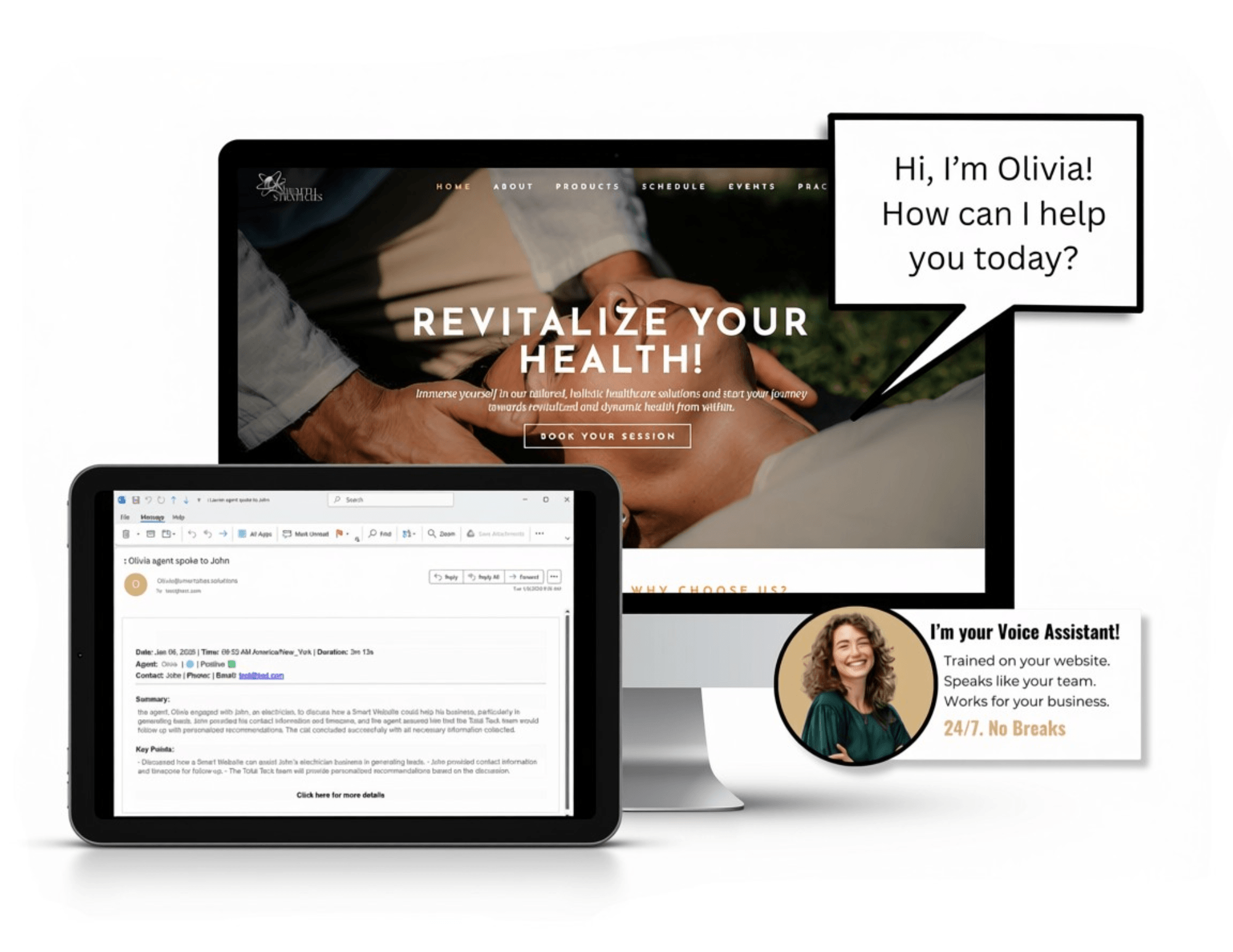
A Smart Website is a website that combines custom design with an AI voice assistant trained specifically on the company’s information, along with automation, intelligent lead capture, integrations, and interactive functionality. Instead of simply presenting information, it can answer questions in the business’s own voice, understand visitor needs, collect qualified leads, initiate workflows, and help customers take action around the clock.
Websites Are Built to Be Visited. Now They Can Actually Do Something.
For most of the internet’s history, business websites have followed essentially the same model. A company publishes information, a visitor arrives, reads a few pages, and hopefully takes an action. The design has improved dramatically over the years, but the fundamental relationship between the website and the visitor has remained surprisingly static.
That model is beginning to change. Artificial intelligence, automation, conversational interfaces, smarter forms, and increasingly sophisticated integrations are transforming what a website can actually accomplish. Instead of simply displaying information, modern websites can interact with visitors, understand what they need, collect meaningful information, initiate workflows, answer questions, and help move customers toward the next step.
That is the idea behind a Smart Website.
A Smart Website is not just a traditional website with an AI chatbot added on top. Our Smart Websites combine professional custom design with an AI voice assistant that is trained specifically on the company’s information, allowing the website to speak in the business’s own voice, understand its services, and respond accurately to real customer questions.
This combination turns the website into something far more powerful than a brochure. It becomes an interactive system that can guide visitors, answer questions instantly, and support real business operations.
The shift is subtle but significant.
Yesterday’s website said:
“Here’s what we do.”
Tomorrow’s website asks:
“What can I help you accomplish?”
Table of Contents
1. Websites Are Built to Be Visited. Now They Can Actually Do Something.
3. Traditional Websites vs. Smart Websites
4. What Makes a Website Smart?
5. How Smart Websites Change the Customer Experience
6. Turning Your Website Into a Business Tool
What Is a Smart Website?
A Smart Website is a website designed to do more than display information. It combines traditional website design and development with intelligent functionality that allows the site to interact with visitors, respond to their needs, and connect what happens online with the systems a business uses behind the scenes.
A defining feature of a Smart Website is the AI voice assistant trained specifically on the company’s information. This means the assistant is not generic. It is built using the business’s services, tone, processes, FAQs, and internal knowledge so it can respond accurately and consistently as if it were part of the team.
The result is a website that can:
- Answer real customer questions in natural language
- Explain services using the company’s own wording
- Guide visitors based on intent
- Support sales and customer service 24/7
The exact definition will continue evolving because the technology itself is evolving. A Smart Website for one business may include a deeply trained AI voice assistant. Another might use intelligent forms that change based on a visitor’s responses. An ecommerce company might personalize product recommendations, while a service company could automatically qualify leads and route them to the appropriate department.
The common thread is that the website becomes responsive to intent, not just responsive to screen size.
Traditional responsive design asks whether someone is visiting from a desktop computer, tablet, or phone. A Smart Website begins asking a much more interesting question: What is this person trying to accomplish, and how can the website help them do it?
That shift changes the role of the website completely.
Instead of being a destination people visit to find information, it begins functioning as an active participant in the customer journey.
From Digital Brochure to Digital Employee
The phrase “digital brochure” has been used to describe websites for years, and for many businesses, it’s still accurate. Their website contains a homepage, a few service pages, an About page, and a contact form. Visitors browse the information and then have to take the next step themselves.
There’s nothing inherently wrong with that model. A professionally designed informational website can still be extremely effective. But technology now allows businesses to ask much more of their online presence.
Imagine a prospective customer visits a contractor’s website at 9:30 at night. They’re interested in replacing their roof but have questions about financing, service areas, materials, and how estimates work.
On a traditional website, they search through pages and wait until the next day for a response.
On a Smart Website, they can speak directly to an AI voice assistant trained on that contractor’s exact services and processes. The assistant can:
- Explain roofing options using the company’s terminology
- Confirm service areas
- Answer financing questions
- Collect project details
- Help qualify the lead instantly
The contractor hasn’t added another employee to the night shift. The website simply became more capable. That’s the opportunity Smart Websites create.
Traditional Websites vs. Smart Websites
The easiest way to understand a Smart Website is to compare it with the websites most businesses use today.
A traditional website is primarily informational. Its job is to present content and encourage the visitor to take action.
A Smart Website is both informational and interactive, powered by a trained AI voice assistant and connected systems that respond to user intent.
| Traditional Website | Smart Website |
|---|---|
| Displays information | Interacts with visitors |
| Static contact forms | Intelligent lead capture |
| Visitors search for answers | AI voice assistant answers questions |
| Standard navigation | Intent-driven experiences |
| Manual follow-up | Automated workflows |
| Generic experience | Personalized responses |
| Business-hours support | 24/7 AI voice assistant support |
| Standalone website | Connected business platform |
| Basic analytics | Deeper behavioral insights |
| Visitors take the next step | Website helps facilitate the next step |
This doesn’t mean every traditional feature should disappear. Visitors still need clear navigation, professionally written service pages, strong calls-to-action, testimonials, case studies, and contact information.
The intelligence sits on top of that foundation. A Smart Website should still be an exceptional website first.
Smart Doesn’t Mean Complicated
One of the risks surrounding AI is the temptation to add technology simply because it’s available.
That’s not what makes a website smart. A website overloaded with popups, automated messages, animations, forms, and AI features can easily become less useful than a simple traditional website. Technology should remove friction, not create it. Sometimes the smartest feature is remarkably simple.
For example, a commercial real estate website might include a custom investment calculator. A visitor can enter a few numbers and immediately evaluate a potential property. No AI is required. Yet the website becomes more useful because it helps the visitor accomplish something.
The same principle applies to AI voice assistants, appointment scheduling, product selectors, customer portals, interactive maps, intelligent forms, and automated quote requests.
Smart Websites aren’t defined by how much technology they contain. They’re defined by how intelligently the technology is used.
What Makes a Website Smart?
There isn’t a universal checklist because the right functionality depends on the business. A restaurant, contractor, medical practice, manufacturer, and ecommerce company all have different customers and workflows.
However, several technologies are increasingly becoming part of intelligent website experiences.
AI Website Assistants (Trained on Your Business)
AI assistants represent one of the most visible changes happening to business websites.
Unlike generic chatbots, Smart Websites use an AI voice assistant trained specifically on the company’s information. This means it understands:
- Services and pricing structure
- Company policies and processes
- Tone of voice and branding
- Frequently asked customer questions
- Industry-specific terminology
A visitor might ask:
“Do you build ecommerce websites?”
Then follow with:
“Can you connect one to our inventory system?”
Then:
“How long does something like that usually take?”
Instead of forcing the visitor to search through pages, the AI voice assistant responds naturally using the company’s own knowledge base. It doesn’t replace the website. It becomes a voice for the website.
Voice Changes the Experience Again
Typing isn’t always the easiest way to interact with a website.
Voice-enabled AI assistants allow visitors to speak naturally, creating an experience closer to having a conversation with someone from the business.
This is especially powerful when combined with a trained AI voice assistant, because the responses feel consistent with the company itself. A visitor can simply ask what they need and receive an immediate spoken response.
Navigation won’t disappear, but it may no longer be the only way people find what they need.
Intelligent Lead Capture
Traditional contact forms treat every visitor essentially the same.
A smarter approach happens through an AI voice assistant that captures leads naturally within conversation instead of relying solely on static form fields. As a visitor speaks with the assistant, it can ask follow-up questions in real time based on what they’re trying to accomplish, gradually collecting key details like name, contact information, project needs, and timeline without feeling like a form at all.
If someone says they need a new website, the assistant can naturally explore goals and required features. If they mention support, it can request a URL and details about the issue. If they’re interested in ecommerce, it can ask about products, systems, and order volume as part of the conversation flow.
The customer feels like they are simply getting help. The business receives structured, high-quality lead information in the background.
Automated Workflows
What happens after someone submits a form is just as important as the form itself.
Instead of just sending an email, Smart Websites can:
- Route leads automatically
- Create CRM records
- Trigger follow-up sequences
- Notify the right team instantly
- Start onboarding workflows
The website becomes the beginning of a process, not the end of one.
Total Teck Perspective
We define a Smart Website by what it accomplishes, not by how many AI features it contains. Sometimes the right solution is a trained AI voice assistant. Other times it’s automation, a calculator, or a customer portal. The goal is always the same: remove friction and improve outcomes.
How Smart Websites Change the Customer Experience
The greatest opportunity created by Smart Websites isn’t technological. It’s experiential.
Customers want:
- Faster answers
- Less friction
- Clear guidance
- Consistent information
- 24/7 availability
A Smart Website delivers this through a combination of design, automation, and a trained AI voice assistant that represents the business accurately at all times.
Immediate Answers Create Momentum
Timing matters. An AI voice assistant allows visitors to get answers instantly instead of waiting for business hours, keeping momentum alive when interest is highest.
Better Information Creates Better Follow-Up
Instead of vague inquiries, businesses receive structured, meaningful context that improves every sales conversation.
Turning Your Website Into a Business Tool
Smart Websites connect your website to your business systems in a way that transforms it from a passive marketing asset into an active operational hub. Instead of existing separately from the tools your team uses every day, the website becomes the central entry point where customer activity is captured, organized, and distributed to the right systems automatically.
This means your website is no longer just where people learn about your business—it becomes where real business activity starts and flows through.
When properly connected, a Smart Website can reduce manual work, eliminate repetitive data entry, and ensure that every inquiry, booking, or purchase is immediately routed to the correct place. Leads no longer sit in inboxes waiting to be processed. Customer actions no longer depend on someone on your team noticing and responding. The system handles the structure, while your team focuses on the work that actually requires human attention.
This includes:
- CRM integration
- Scheduling systems
- Customer portals
- Internal workflows
- Ecommerce systems
Each of these connections plays a different role, but together they create a unified digital ecosystem where your website becomes the central control point.
The website becomes the front door to your entire operation, not just a brochure, but a functioning part of how your business runs day to day.
Interactive Tools and Calculators
Interactive tools and calculators turn your website from a passive reading experience into an active problem-solving environment. Instead of asking visitors to interpret information on their own, these tools allow them to input their own data and receive immediate, personalized results.
This shift is powerful because it changes how users engage with your content. Rather than simply reading about your services or products, they begin to experience them in a practical, hands-on way.
For example, a pricing calculator can help a potential client understand what their project might cost based on their specific requirements. An ROI calculator can show the financial impact of a service or investment. A product configurator can guide users through selecting the right options based on their needs. Even simple assessment tools can help qualify leads by identifying what stage of the buying journey a visitor is in.
These tools do more than provide convenience—they build confidence. When users can see personalized outcomes instantly, they are more likely to trust the information and move forward in the decision-making process.
From a business perspective, interactive tools also improve lead quality. Instead of receiving vague inquiries, you gain structured, meaningful data about what the customer actually needs. This allows your team to respond more effectively and close deals faster.
In many cases, these tools become some of the most valuable parts of a website because they actively help users reach decisions instead of waiting for them to figure things out on their own.
Building a Website for What Comes Next
The future of websites is not just design—it is intelligence, conversation, and integration.
Businesses that prepare now will be able to adapt faster as expectations evolve, rather than constantly reacting to new tools, platforms, and customer behaviors after the fact. The companies that win in the next era of the web will not necessarily be the ones with the most visually impressive websites, but the ones whose websites are built to evolve, connect, and respond to change.
A modern website is no longer a static asset. It is becoming a living system that sits at the center of marketing, sales, customer service, and operations. When built correctly, it can grow alongside the business instead of becoming outdated every few years.
Search Is Becoming Conversational Too
People are no longer just searching; they are asking.
Instead of typing short keyword phrases like “roof repair cost” or “web design company near me,” users are increasingly asking full, natural questions such as:
- “How much does it cost to replace a roof in my area?”
- “What’s the best platform for a small business website?”
- “Who can help me automate my customer intake process?”
This shift changes everything about how websites need to be structured.
Smart Websites must be designed so both humans and AI systems can understand them clearly. That means content should be organized around real questions, real problems, and real intent, not just keywords. Information should be easy to extract, interpret, and reuse across search engines, AI assistants, and voice interfaces.
In this environment, clarity becomes a competitive advantage. The businesses that explain themselves best will be the ones that get surfaced most often—not just in traditional search results, but in AI-generated answers and conversational recommendations. A Smart Website doesn’t just rank well. It communicates well.
Total Teck Perspective
The next generation of websites will be measured by what they can do, not how many pages they have. A Smart Website is not defined by its size or complexity, but by its ability to understand intent, reduce friction, and actively support business outcomes.
Smart Doesn’t Mean Removing the Human Element
Automation should support people, not replace them.
One of the biggest misconceptions about Smart Websites is that they are designed to eliminate human involvement. In reality, the goal is the opposite. The purpose of automation, AI, and intelligent systems is to remove repetitive, low-value tasks so that people can focus on higher-value interactions.
The best Smart Websites do not replace conversations, they improve them.
For example, instead of a sales team spending time answering the same basic questions over and over, a Smart Website can handle those initial inquiries instantly. By the time a human steps in, the customer is already informed, qualified, and ready for a meaningful discussion.
This creates a better experience on both sides.
Customers get faster answers and less friction. Businesses get more focused conversations and better-prepared leads.
In this way, technology becomes a filter, not a barrier. It ensures that when a human interaction does happen, it is more valuable, more relevant, and more productive.
A Smart Website should always feel like it is working with your team, not instead of it.
What Should Your Website Be Doing That It Isn’t Today?
This is the most important question:
Where are customers experiencing friction right now?
Friction is anything that slows down understanding, delays action, or creates unnecessary effort. It might be:
- Customers waiting too long for answers
- Leads arriving without enough context
- Staff manually re-entering the same information
- Visitors struggling to find the right service or product
- Opportunities lost after hours when no one is available to respond
Every one of these moments represents a gap between what your website currently does and what it could be doing. That is where Smart Website technology creates value.
Not by adding complexity for its own sake, but by removing obstacles that already exist. The goal is to make the path from interest to action as smooth and intuitive as possible. When a website starts solving these problems automatically by answering questions, guiding users, capturing better data, and triggering internal workflows, it stops being just a marketing tool and becomes a core part of how the business operates.
And once that shift happens, the website is no longer something you simply maintain. It becomes something that actively helps you grow.
The Short Answers:
1. What exactly is a Smart Website?
A Smart Website is a modern website that goes beyond static pages by using AI, automation, and interactive tools to help visitors get answers, submit information, and complete actions more efficiently.
2. How is a Smart Website different from a normal website?
A normal website mainly displays information, while a Smart Website actively interacts with users, guides them based on intent, and can automate tasks like lead capture, scheduling, and customer support.
3. Can a Smart Website replace live customer support?
It can handle many common questions and tasks, but it is not meant to fully replace human support. Instead, it reduces repetitive inquiries so your team can focus on more complex or high-value interactions.
4. Can a Smart Website help me get more leads?
Yes. By improving how visitors interact with your site, through better forms, AI assistance, and guided experiences, you can capture more qualified leads and reduce drop-offs.
5. Is a Smart Website only for large businesses?
No. Small and medium-sized businesses often benefit the most because automation and AI tools can save time, reduce workload, and help teams operate more efficiently.
6. Can a Smart Website integrate with my existing tools?
In most cases, yes. Smart Websites can connect with CRMs, email platforms, scheduling tools, and other business software depending on your setup.
7. Do Smart Websites improve customer experience?
Yes. They reduce friction by giving visitors faster answers, personalized interactions, and easier ways to complete actions like booking or requesting information.
8. Is a Smart Website worth the investment?
If your business relies on online leads, customer interactions, or digital workflows, a Smart Website can significantly improve efficiency, conversions, and overall user experience, making it a strong long-term investment.
Final Thoughts…
Instead of acting as a passive collection of pages, your website should become an active layer of your business, one that can interpret questions, guide visitors through decisions, communicate the right information at the right time, and support users in real time without requiring human intervention for every interaction.
This shift changes the role of a website entirely. It is no longer just a place where people go to read about a business; it becomes a system that participates in the customer journey. It can qualify leads before they ever reach your inbox, help customers understand complex services without waiting for a callback, and reduce friction in moments where interest is highest but attention is fragile.
In practice, this means your website can behave less like a brochure and more like a knowledgeable extension of your team that’s available 24/7, consistent in its responses, and always aligned with the information and processes you define. The AI voice assistant is one part of that experience, but the broader value comes from how all of these systems work together: content, automation, data capture, and conversational intelligence operating as a unified structure rather than separate tools.
The question is no longer:
“What should be on our website?”
It is:
“What should our website be able to do?”
Make Your Website Work Smarter
At Total Teck, we build Smart Websites that combine custom design with AI voice assistants trained specifically on your business, along with automation, integrations, and custom functionality built around your goals.
We don’t just add technology. We build websites that understand your business.
Related Posts:
Beyond Templates: Why Custom Websites Win More Customers
The Quick Answer: A custom website is designed and developed specifically for your business rather than built from a pre-made...
SEO vs. AEO vs. GEO: Which One Actually Matters for Your Business?
The Quick Answer: SEO (Search Engine Optimization) helps your website rank higher in traditional search results. AEO (Answer...